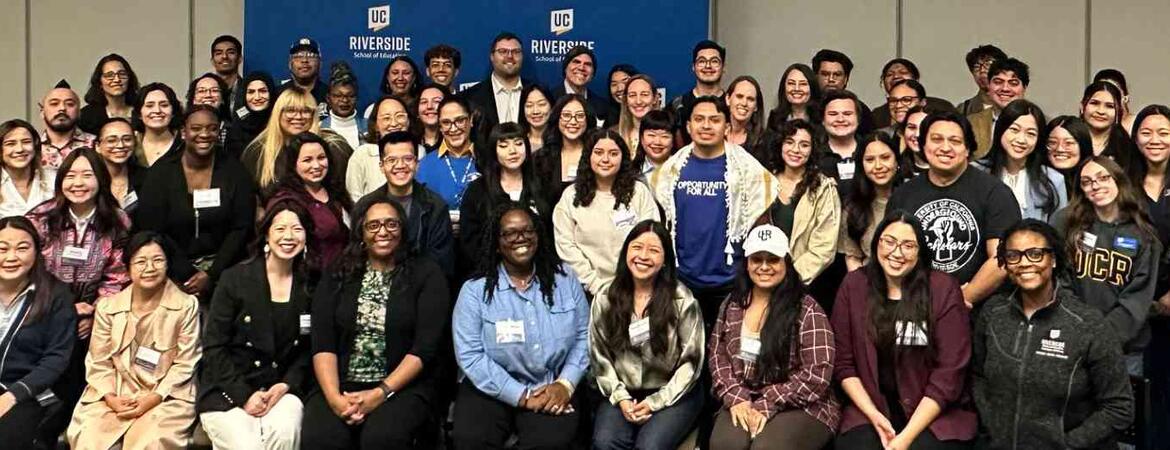
Doctoral students at the University of California, Riverside School of Education (SOE) face the same expectations as doctoral students anywhere: research, publish, develop deep expertise in their subject area. What sets them apart is how they get it done. Together, they have created a unique support system that serves as mentor, peer, and friend.
Working alongside faculty advisor and associate professor Dr. Alice Lee, SOE students built this support system as a coalition of care for students who need more than academic rigor while developing their expertise in pursuit of their Ph.D. The coalition is known as the Pre-Professoriate Thriving Program.
The program’s roots reach back to the fall of 2020, when the doctoral community lost one of its own. Margarita Vizcarra was a Chicana feminist and a first-generation college student who advocated for the people around her — for living wages, for stronger support for teaching assistants, for the basic dignity of graduate workers. Her death was a profound loss, but the work she had poured herself into did not end with her. It was carried forward by students who had stood beside her, among them Ariana Romero and Patriccia Ordoñez-Kim
Beginning in the winter of 2021, Dr. Lee listened to graduate students over Zoom and by phone. They spoke warmly of the mentorship they had received from longstanding faculty and of the grounding their coursework gave them; still, they named needs that no single course or mentor could meet. Many felt underprepared to carry out the qualitative research their dissertations required. Others worried about conferences, publications and the job market. Beneath the practical gaps was something heavier: loneliness, anxiety and, for some, a quiet sense of being second-class next to peers at other UC campuses. “Our doctoral students already have the leadership and brilliance,” Dr. Lee said. “They just need to be seen and supported.”
From those conversations, Dr. Lee shaped a vision she would later put to the students. The success of a graduate program is defined by much more than the number of degrees awarded or the number of articles published. It also should be defined by the quality of their overall experience. Thus she sought to develop "a scholarly community in which students grow as independent researchers and find belonging alongside one another." In other words, she envisioned a more supportive environment that would lead to better work and a better scholar.
The program began as a pilot in the fall of 2022. Made possible by a $35,000 commitment from Dr. Lee’s graduate student research funds, Sofia Rivas and Esmeralda Muñoz, were hired to help lead it.
The first component was a redesigned qualitative research course series, with structured methods training and mentorship, developed in collaboration with assistant professor Dr. Michael Moses and assistant professor of teaching Dr. Amos Lee, with Dr. Lee serving as the School’s faculty lead for qualitative research from 2022 – 2026. The series offers quarterly workshops which are now offered school-wide and cover quantitative methods as well.
The second component is an annual graduate research conference that was designed to be a real platform for professional development and “not merely a line for your CV,” said Alice Lee. It was meant to push against the traditional, sometimes colonial conventions of how research gets done and on whom, and to build a space rooted in warmth, belonging and care. The conference has drawn nationally recognized keynote speakers, among them Dr. Danny C. Martinez (UC Davis), Dr. Carmen Kynard (Texas Christian University), Dr. Venus E. Evans-Winters (University of San Diego) and Dr. Jessica T. DeCuir-Gunby (University of Southern California).
For the third component, the Pre-Professoriate Thriving Program added a wellness retreat – this one proposed by a student. It was Ariana Romero, a close friend of Margarita, who suggested turning two components into three: the people most affected by the work helping to shape it. Ariana led the first retreat in the spring of 2023, and it is now considered integral to the SOE doctoral experience. “The student response to advancing these changes gave me life during one of the darkest periods of my career and amid multiple global pandemics,” Ariana said. “What sustained me was the compassion, vulnerability, and unwavering commitment of my peers, and Dr. Alice Lee — people who became family through this work. Through tears, honest conversations, and collective action, I witnessed hope emerge and a meaningful shift in our culture begin to take root.”
As that first year’s funds began to dwindle, support came at the level of the School. Dr. Joi Spencer, newly the dean of the School of Education, put institutional weight behind the work, committing staff and funding for graduate student support. In the winter of 2025, the School’s Writing and Research Center took on the staffing of the program, giving it a lasting home, and from January 2025 through January 2026 Dr. Lee mentored the Center’s director and staff so the work could continue without her. In 2025, Dr. Lee received UC Riverside’s campus-wide Commitment to Graduate Diversity Award.
The public life of the program has belonged to students by design. Sofia and Esmeralda co-chaired the conference, and Dr. Lee, who served as faculty advisor from 2022 to 2026, kept the visible leadership with them.
“Co-leading this program allowed me to have experiences that didn’t exist within the SOE,” Sofia said, “experiences that centered the well-being and academic excellence of my peers and allowed us to grow together while supporting each other.”
Esmeralda describes the same work as a labor of love. “To witness intentional programming for underrepresented students of color was such a rewarding undertaking,” she said. “This opportunity opened avenues for graduate students to collaborate with SOE leadership and find a deep sense of belonging.”
According to Dr. Lee, the impact of the program is the community that it has developed. She notes that morale has shifted and the culture has changed. Students feel more prepared and more confident. Students coming through the redesigned research series describe feeling prepared and confident for independent research, and many more are moving through their programs on time.
Born from need but developed with care, the Pre-Professoriate Thriving Program is now considered essential to doctoral student scholarship and success at the SOE. Cohorts turn over, and those who build something are not always the ones who inherit it; the annual conference continues in the memory of the sister-scholar whose advocacy first inspired it. “It’s so rare to see something come full circle.” Dr. Lee said. “To see the fruit of that labor – it has been life-giving.”
Let us help you with your search